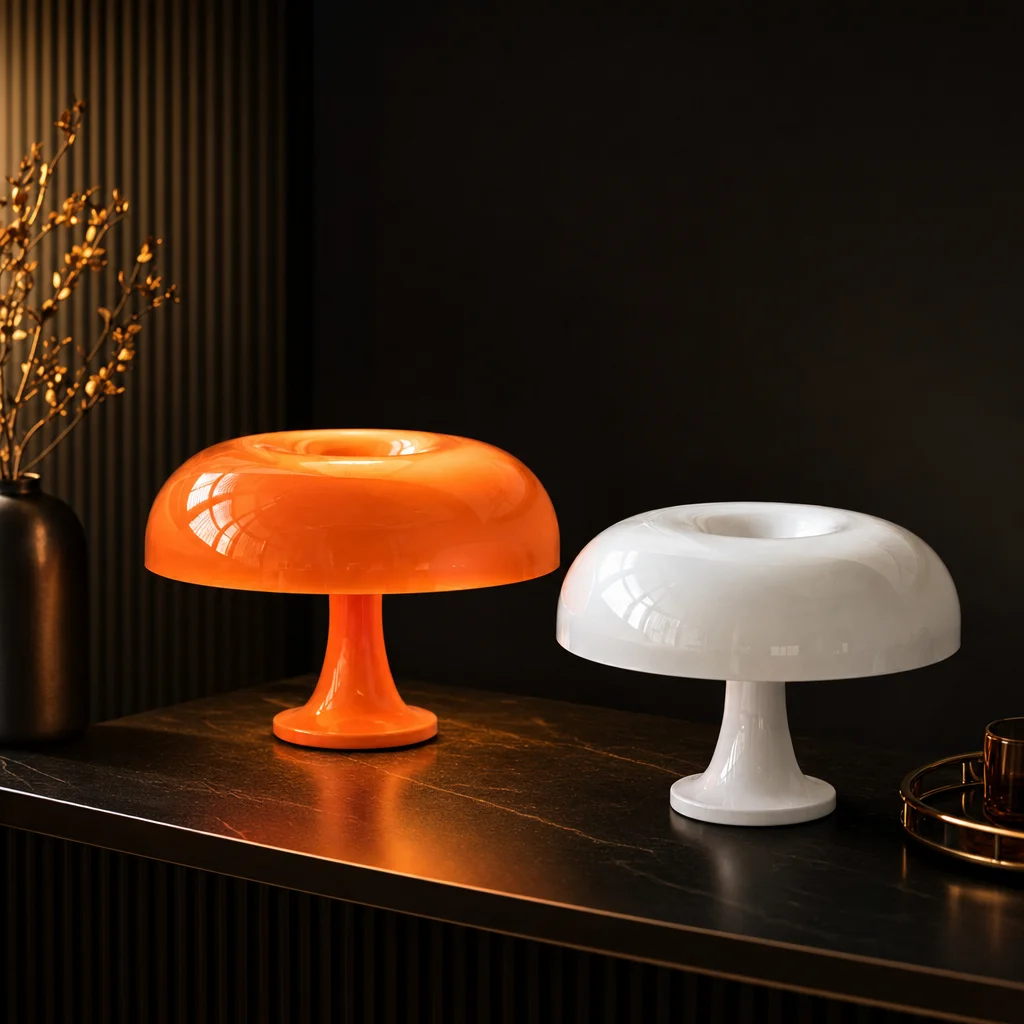
What Is a Mushroom Lamp? The Shape, the Light, and Why It Works
A mushroom lamp is a table lamp defined by its silhouette: a wide, rounded dome sitting on a short stem or squat base, so the whole thing reads as a single continuous curve rather than a base with a separate shade perched on top. The name is purely descriptive. Nothing about the wiring, the bulb, or the brightness is implied by it, which is why two mushroom lamps can look similar and behave very differently once switched on.
The shape is doing real work
The dome is not only decorative. Because the shade curves down past the light source, it screens the bulb from view at almost every normal sitting or standing angle. That is the single most useful property of the form. Most discomfort from a lamp comes from seeing the bright source directly, not from the room being too bright overall, so a shape that hides the source tends to feel calm even at moderate output.
The second effect is where the light goes. A closed dome pushes light downward and outward across the surface it stands on, creating a defined pool rather than an even wash across the whole room. That makes a mushroom lamp a strong accent and ambient light, and a weak choice as the only light in a room.
What that means in practice
- It flatters a surface. A pool of light on a nightstand, console, or shelf gives a room a visible warm centre after dark.
- It fills corners poorly. Light held low and directed down will not reach a far wall or ceiling, so a dark corner needs its own source.
- It is comfortable at eye level. Because the bulb is screened, the lamp can sit close to where you sit without becoming glaring.
Ambient light, not task light
It is worth being clear about this, because it is the most common mismatch between expectation and reality. A mushroom lamp is an ambient and decorative light. For sustained close work — reading a paperback for an hour, sewing, writing — you want a source you can aim at the page from beside and slightly behind your shoulder. A domed lamp cannot be aimed.
The practical answer is not to choose between them but to layer them. Use the mushroom lamp for atmosphere and a dedicated adjustable light for the task. Our guide to ambient lighting versus task lighting explains how the two layers divide up a room, and the best lighting for reading covers where a focused source needs to sit.
What to check before buying one
Because the category is defined by looks, specifications vary widely. Five things are worth confirming:
- Footprint, not just height. Measure the widest point of the dome against your available surface. A dome overhangs its base, so the base measurement understates the space it occupies.
- Whether it dims. A fixed-output lamp is a very different object in the evening from one you can take down to a low glow.
- How it is powered. USB power gives flexible placement but needs a USB source nearby; check whether a wall adapter is included or supplied separately.
- Where the control sits. A control you have to reach across furniture for will not get used. Touch control on the body of the lamp is the easiest to operate in the dark.
- Light colour. Warm light around 2200K–2700K suits evening use. Our colour temperature guide sets out the ranges.
Where the form suits a room
The shape is compact and low, which points it toward surfaces rather than floors: a bedside table, a desk beside a screen, a shelf, a console behind a sofa. It reads as an object during the day, which matters more than people expect, since a lamp spends most of its hours switched off. For a full walkthrough of positions and clearances, see the mushroom lamp placement guide.
The Lumière Home Mushroom Lamp is built to the description above: a dimmable LED with three light modes, touch control on the body, USB power, and a 28 × 19.5 cm form in orange or white.
Written by Lumière Home Editorial Team