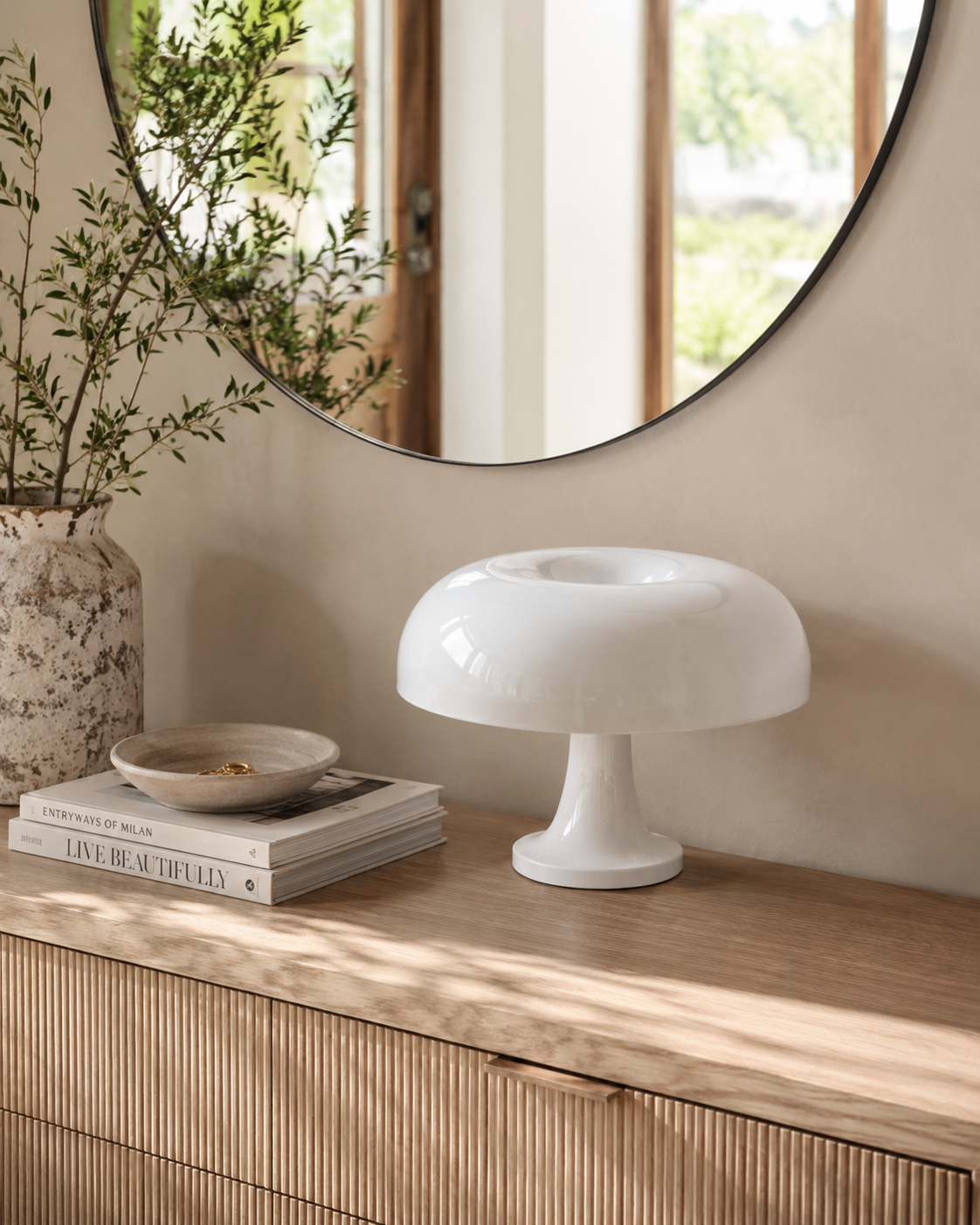
Are Mushroom Lamps Still in Style? An Honest Answer
Short answer: yes, but not for the reason the question usually assumes. The mushroom lamp is not a passing trend that arrived in the last few years. It is a mid-century form that has been in continuous production in one shape or another since the 1960s, which is a fairly reliable signal that it is not about to look dated.
Why the shape has lasted
Trends fade when they depend on a specific finish, colour, or reference that ages. The mushroom silhouette survives because it solves a practical problem: a curved dome that extends past the light source hides the bulb from view. That was useful in 1965 and it is useful now. Forms that do a job tend to outlive forms that only make a statement.
It also happens to be an easy shape to live with. It has no sharp corners, no visible hardware, and no strong stylistic accent, so it sits comfortably against furniture in almost any register — a plain oak nightstand, a lacquered console, a painted shelf.
What actually dates a lamp
If you are worried about a lamp looking tired in three years, the silhouette is rarely the culprit. Four other things are:
- A very specific colour. A saturated trend colour will date faster than the shape it is applied to. A warm neutral or a considered accent tone ages better than whatever is currently everywhere.
- Visible cheap material. Thin, glossy plastic with visible seams reads as disposable regardless of form. Weight and a well-finished surface do most of the work here.
- Harsh light. A cool, bright, undimmable output makes any lamp feel unwelcoming, and people quietly stop using it. This is the most common reason a lamp ends up in a cupboard.
- Wrong scale. A lamp that is too large for its surface looks like a mistake, not a style choice. See our table lamp size guide for the proportions that read as intentional.
How to buy one that stays right
Prioritise how it behaves over how it photographs. In practice that means three decisions.
Choose warm and dimmable
A lamp you can take down to a low glow gets used every evening. A fixed bright output gets used until the novelty wears off. Warm light around 2200K–2700K is what makes a room feel settled after dark; our guide to warm versus cool light covers the ranges and where each belongs.
Choose a colour you already live with
Look at the textiles and wood tones already in the room rather than at a mood board. A white dome disappears into a neutral scheme and lets the shape do the talking. A warm orange reads as a deliberate accent and works best when something else in the room already picks up that tone — a rug, a book spine, a timber finish.
Choose a size that leaves the surface usable
A bedside lamp competes with a phone, a glass of water, and a book. If the dome takes most of the surface, the lamp loses. Measure the widest point of the dome, not the base, and keep it to roughly a third of the available surface.
Where it fits today
The form suits the way people actually light rooms now, which is with several low, warm sources rather than one bright ceiling fixture. A compact domed lamp is exactly the kind of secondary light that layered approach needs — on a nightstand, a shelf, a desk beside a screen, or a console behind a sofa. Our guide to making a room feel warmer after dark explains how those layers stack.
The Lumière Home Mushroom Lamp was designed against the checklist above: three dimmable light modes, touch control, USB power, and a choice of a neutral white or a warm orange finish.
Written by Lumière Home Editorial Team