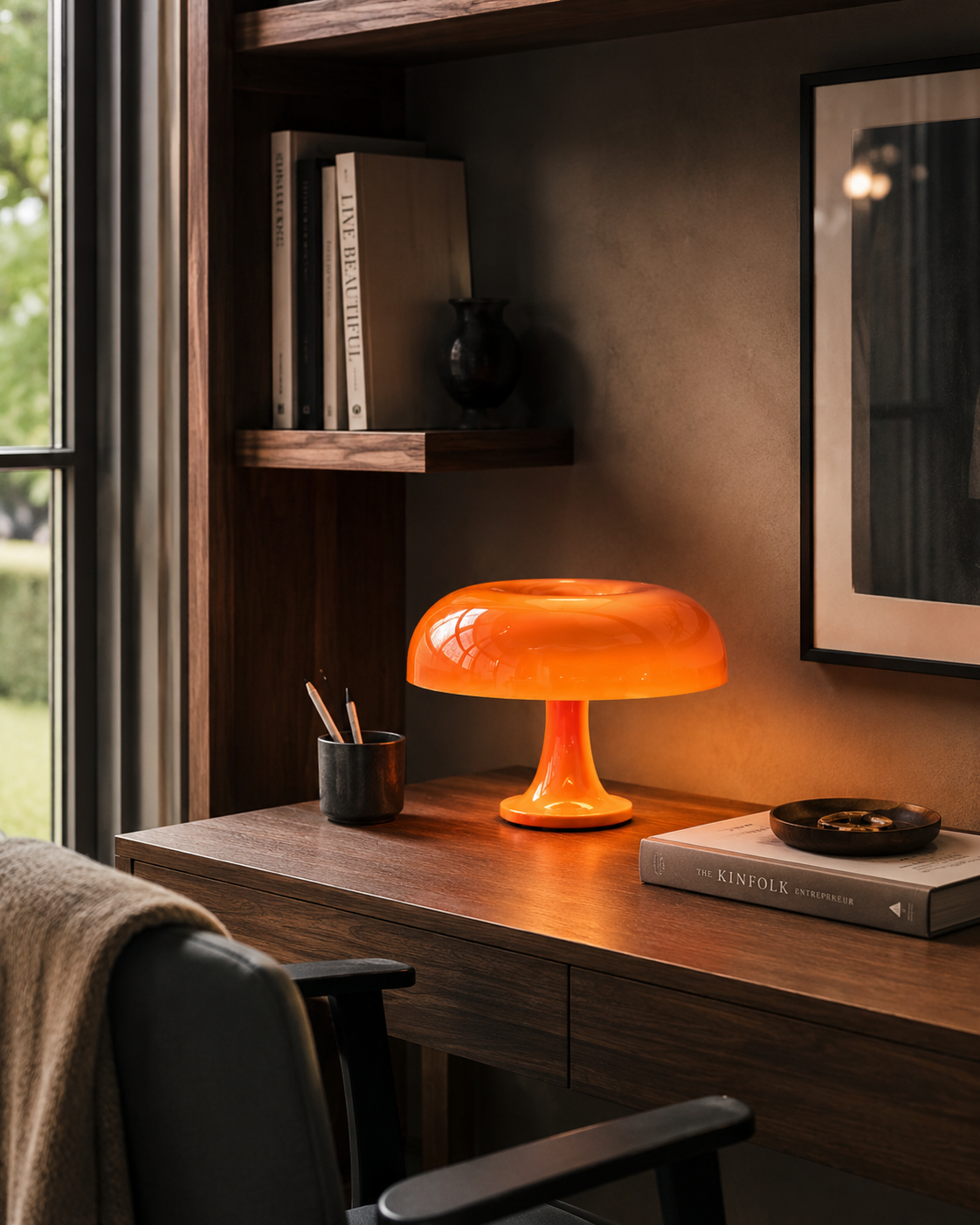
Orange or White Mushroom Lamp: How to Choose the Finish
The finish is the one decision people hesitate on longest, and it is the one that changes the least about how the lamp performs. Both finishes give the same light. What differs is how the lamp reads during the day, when it is switched off — which is most of the hours it will spend in your room.
Start with a simpler question
Instead of asking which colour is better, ask what job the lamp is doing on that surface:
- Should it recede? If the surface is already busy, or the room is deliberately quiet and tonal, you want the lamp to add light without adding a focal point. Choose white.
- Should it register? If the surface is bare, or the room is neutral and needs one point of warmth, the lamp can be the accent. Choose orange.
That single question resolves most cases faster than comparing swatches.
When white is the right call
White works with almost everything, which is both its strength and its limitation. It suits pale walls, linen, light oak, and marble, and it stays calm against patterned bedding or wallpaper where a strong colour would compete.
It is also the safer choice for a room you expect to change. Repainting a wall or replacing a rug will not put a white lamp out of step, whereas a saturated accent is tied to the palette around it.
One practical note: a light dome shows dust and fingerprints more readily than a darker one, particularly on a bedside table you reach for in the dark. Not a reason to avoid it, just something to expect.
When orange earns its place
Warm orange has a specific advantage: it looks lit even when it is not. The finish holds a hint of glow in daylight, which gives a neutral room a warm point to settle on at any hour. Against black metal, walnut, deep green, terracotta, or unbleached linen it looks considered rather than loud.
The rule that keeps it from looking accidental is repetition. An accent colour reads as deliberate when something else nearby echoes it — a timber tone, a book spine, a ceramic, a woven texture. If the orange is the only warm note in an otherwise cool room, it will look like it wandered in from somewhere else.
Test it before you commit
Two checks take five minutes and prevent most regret.
Look at the surface in daylight
Put a plain white object and a warm-toned object on the surface where the lamp will sit, then look at the arrangement from the doorway. Whichever feels like it belongs is your answer, and it is usually obvious immediately.
Look at the room after dark
Switch off the overhead light and see what is already lit. If the room already has warm timber and warm bulbs, white keeps the composition from tipping too far amber. If everything reads cool and grey, orange does more work.
What does not change between the two
Worth stating plainly, because it takes the pressure off the decision. Both finishes are the same lamp: the same 28 × 19.5 cm form, the same three dimmable light modes, the same touch control on the body, the same USB power, the same warm output. Neither is brighter, warmer, or easier to use than the other.
So the finish is a styling decision, not a performance one. If you are genuinely torn, choose based on the surface it will live on rather than the room as a whole — that is the thing you will actually look at.
For placement and clearances once you have chosen, see the mushroom lamp placement guide, and for how the lamp fits into a wider lighting plan, our guide to small bedroom lighting ideas. Both finishes of the Lumière Home Mushroom Lamp are shown side by side on the product page.
Written by Lumière Home Editorial Team