Mushroom Lamp Placement Guide
Mushroom lamps work best where their rounded shade can be seen without the brightest part sitting in a direct eye line: beside a bed, at the quieter edge of a desk, on an uncrowded shelf, beside a sofa, or on an entry console. The right position is less about a fixed height and more about the relationship between the lamp, the surface, the viewer, nearby objects, and the cable.
At-a-glance planning tool
Quick placement matrix
Use these as starting points, then test the lamp in the real room after dark. Surface dimensions, shade proportions, wall color, eyesight, and surrounding light all change the result.
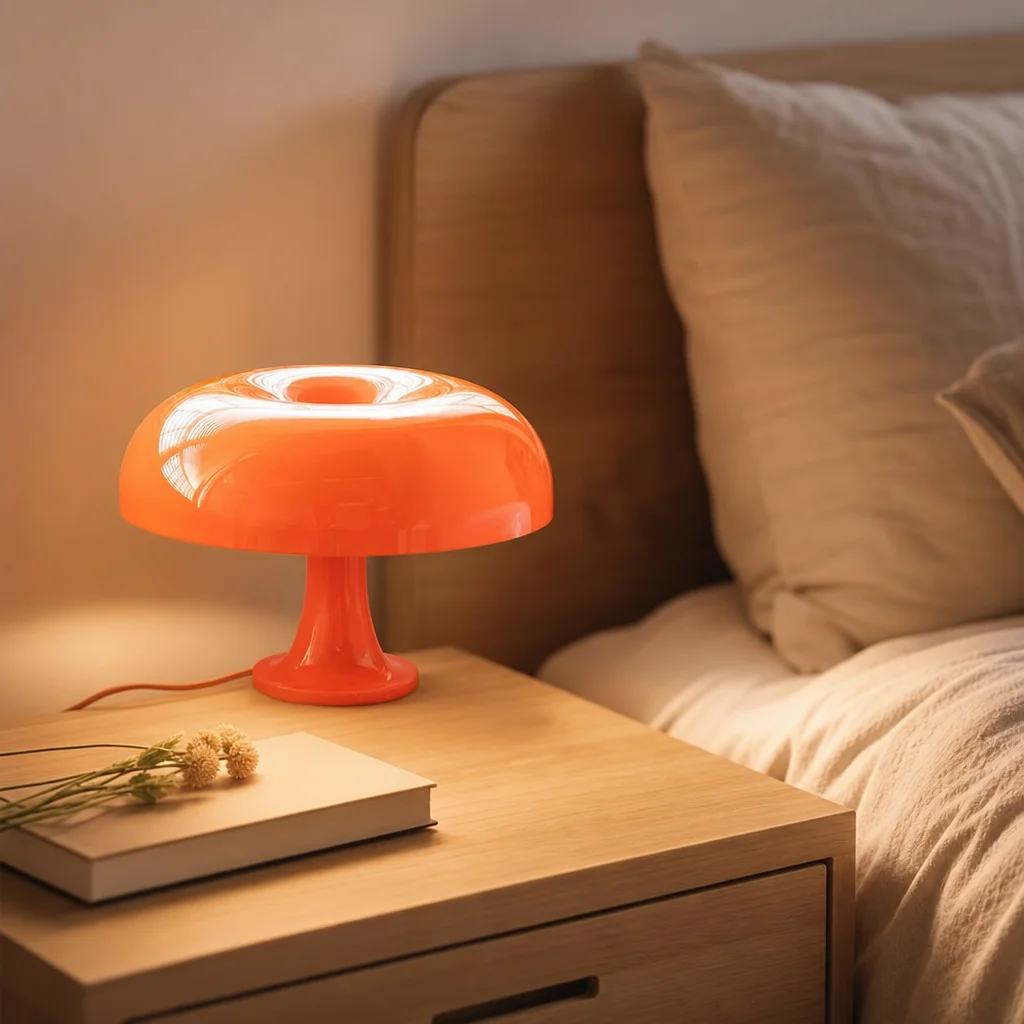
Bedside table
- Visual goal
- A low, calming pool of light that feels balanced with the bed.
- Practical placement check
- From your normal lying or seated position, the shade should screen the brightest area. Keep the control within relaxed reach.
- Glare risk
- High if the glowing underside or diffuser sits directly at eye level.
- Control setting
- Begin on the lowest mode; raise it only for finding objects or short reading.
Desk
- Visual goal
- A sculptural background layer that softens screen contrast.
- Practical placement check
- Place it to the side of the display and test the screen for reflections from your working position.
- Glare risk
- Medium to high if it faces the eyes or reflects in a glossy screen.
- Control setting
- Low or medium for screen work; use a separate directed task light for detail.
Shelf
- Visual goal
- A rounded focal point with a gentle wall wash.
- Practical placement check
- Support the whole base, allow clearance around the shade, and make sure the control remains easy to reach.
- Glare risk
- Medium on shelves near seated eye level; lower if the diffuser is concealed.
- Control setting
- Low for display; medium only if surrounding objects do not create hard shadows.
Living-room side table
- Visual goal
- A warm-looking visual anchor beside seating.
- Practical placement check
- Sit in every nearby seat and check the lamp against television and window reflections.
- Glare risk
- Medium, especially on a table level with a seated viewer.
- Control setting
- Low for conversation or television; medium for general ambient light.
Entry console
- Visual goal
- A welcoming pool of light that defines a landing zone.
- Practical placement check
- Leave clear space for keys and bags, keep the lamp away from the edge, and route the cable behind the console.
- Glare risk
- Low to medium unless the shade meets standing eye level or a mirror doubles the bright source.
- Control setting
- Low after dark; medium when sorting mail or locating small items.
A five-step sizing method for the actual surface
- 1. Map the usable surface. Measure width and depth, then subtract the space needed for a phone, book, keyboard, keys, plant, or drink. Mark the lamp’s full footprint—including the widest shade—with removable tape. As a starting point, preserve a clear working or landing area rather than letting the lamp dominate every available inch.
- 2. Record the real eye line. Sit at the desk or sofa, lie and sit up in bed, or stand at the console. Have another person mark eye height, or photograph the view from that position. A lamp that looks well scaled from the doorway may expose a bright underside from the chair.
- 3. Check the shade position. The shade should interrupt the direct view of the brightest source while still allowing useful light to reach the surface or nearby wall. Raising the lamp can improve spread but also increase glare; lowering it can conceal the source but narrow the pool of light. Test both.
- 4. Trace cable reach before styling. Measure the route to the intended USB power source, including the drop behind furniture and enough slack to avoid strain. Do not plan on a cable running under a rug, across a doorway, through a chair’s wheels, or where a drawer will pinch it.
- 5. Reintroduce nearby objects. Put back the books, frames, screens, mirrors, and daily items. Leave enough open space around the mushroom silhouette to read clearly. Check that tall objects do not cast distracting shadows and that reflective objects do not reveal a second bright hotspot.
Useful mock-up: make a paper outline using the listed lamp width and height, stand it on the surface, and view it from the room’s main approach and normal seats. Dimensions are a starting point; the eye-line and clearance checks decide whether the placement works.
Beside the bed: control reach before symmetry
Begin with the person using the lamp, not a matching pair in a photograph. From a normal resting position, the touch control should be reachable without twisting behind the lamp or leaning beyond the mattress edge. Keep the base fully supported and set back far enough that bedding, a hand, or a book cannot easily knock it.
Next, check the shade from lying, reclined, and seated positions. If the bright area is visible, move the lamp toward the outer edge of the nightstand, lower the surface or lamp, or reduce the setting. For extended reading, add a directed reading light rather than increasing a broad decorative source until the whole bedside area becomes glaring.
When two nightstands differ in height, identical lamps may not look identical in use. Aligning the apparent glow or shade position can matter more than matching the bases. For a deeper bedside sizing method, use the bedside lamp height and scale guide.
On a desk: separate atmosphere from task light
A mushroom lamp is usually strongest as a background layer on a desk. Put it to one side of the monitor, preferably beyond the active keyboard and writing zone. From the working chair, scan dark screens, glossy bezels, framed art, and windows for reflected bright spots.
For writing or drawing, place a focused source on the side opposite your writing hand to reduce hand shadow. Keep the mushroom lamp lower so it softens the contrast between the screen and the room without competing with that task source. Cable routing is especially important: avoid the chair path, drawers, laptop hinges, and crowded multi-port connections.
On a shelf: use negative space as part of the composition
Measure shelf depth at its narrowest point and support the entire base. Confirm the product instructions’ clearance requirements before placing a lamp below another shelf or close to paper, fabric, or plants. The control should remain reachable without pulling on the shade or cable.
Style the rounded lamp against one quieter zone rather than surrounding it with objects of equal height. A short stack of books or one low bowl can counterbalance the form; several tall frames can make the lamp feel squeezed. Turn it on after dark and inspect the wall wash. If the wall shows a sharp hotspot, move the lamp forward or farther from the wall and lower the setting.
Beside a sofa: check every seat, not only the nearest one
A sofa-side lamp becomes part of several sightlines at once. Sit at both ends of the sofa and in any facing chair. The nearest seat may be comfortable while the opposite seat has a direct view into the diffuser. A small shift behind the sofa arm can conceal the source without hiding the sculptural profile.
Keep enough table area for a drink or remote, but do not put liquid where a spill can reach the lamp or USB connection. During television viewing, lower the setting and check the screen from an angle. The aim is a gentle surrounding layer, not a bright reflection beside the picture.
On an entry console: design a safe landing zone
Divide the console into a lit display zone and a practical landing zone. Set the lamp away from the edge and from the place where bags, mail, or keys are dropped. Route the cable down the rear rather than across the top.
A nearby mirror can increase the sense of light, but it can also reflect the brightest part toward the entry. Stand at the front door and at the main hallway approach to test both views. If the reflection is sharp, shift the lamp laterally or reduce the setting. A low bowl and one piece of art usually leave more visual breathing room than a cluster of small accessories.
Light quality: compare the right terms
Lumens describe brightness. More lumens generally means more light output. Watts describe energy use, not brightness, so wattage alone is not a reliable way to compare how bright two modern light sources will appear.
Kelvin describes the warmer or cooler appearance of white light. Lower values look warmer or more yellow; higher values look cooler or more blue-white. Kelvin does not tell you how bright the lamp is.
Exact lumens and Kelvin should be checked in the product documentation. Lumière Home does not currently publish verified lumen or Kelvin values for its Mushroom Lamp, so this guide does not assign either figure to it. The documented three light modes should be judged in your room at the lowest useful setting first. For bedroom context, see the guide to choosing warm versus cool bedroom light.
Material and buying checks
“Mushroom lamp” describes a silhouette, not one construction method. Decorative versions may use glass shades, metal bodies, or combinations of stone, ceramic, and other materials. Glass can offer visual depth but needs careful handling; metal can feel substantial and may direct light differently depending on the shade. Compare weight, stability, finish care, replaceable parts, and the maker’s instructions rather than assuming the shape determines performance.
The current Lumière Home Mushroom Lamp is different from glass or metal decorative lamps. Its documented materials are ABS and PC. It is USB powered, uses touch control, and provides three light modes. Those are product-specific documented facts; they do not establish exact brightness, light color, suitability for every task, or compatibility with every USB power source. Check the product page and included instructions before use.
Save or print
Seven checks before buying
- 1. Measure the usable surface, not only the tabletop.
- 2. Mark the full shade and base footprint.
- 3. Check seated, lying, or standing eye lines.
- 4. Confirm the shade hides the brightest view.
- 5. Trace USB cable reach and a safe route.
- 6. Verify materials, controls, lumens, and Kelvin in the documentation.
- 7. Test the lowest useful setting after dark with nearby screens and mirrors.
Frequently asked questions
How high should a mushroom lamp sit beside a bed?
There is no universal bedside height. Start by placing it so the shade hides the brightest part of the lamp from your usual lying and seated eye lines. Measure the nightstand and mattress together rather than choosing by lamp height alone.
How do I reduce glare from a mushroom lamp?
Move it slightly lower, farther to the side, or farther from a reflective wall or screen. Then use the lowest useful light mode. Check glare from every seat or resting position that faces the lamp.
Is a mushroom lamp suitable for reading?
It can support short, casual reading if the page is comfortably illuminated, but its broad decorative light may not replace a focused reading lamp. For sustained reading, use a directed task light and treat the mushroom lamp as the ambient layer.
What should I check with a USB-powered lamp?
Confirm the supplied cable reaches a suitable power source without crossing a walkway or being pulled tight. Check the product instructions for the required USB power source and keep connections where they will not be crushed or snagged.
Is warm or cool light better for a mushroom lamp?
Warm-looking light often suits relaxing and decorative settings, while a cooler appearance may feel clearer for some tasks. Kelvin describes that appearance, not brightness. Check the product documentation for exact Kelvin and available modes.
Source notes
These independent sources support the lighting terminology used above—especially lumens, watts, brightness, and light appearance. They do not support or verify product-specific claims about the Lumière Home Mushroom Lamp.