Floor Lamps for Living Rooms: Choose by Layout and Use
Choose floor lamps for a living room by reading needs, sofa layout, ceiling height and walking space. Compare shaded, arc, uplight and adjustable designs.
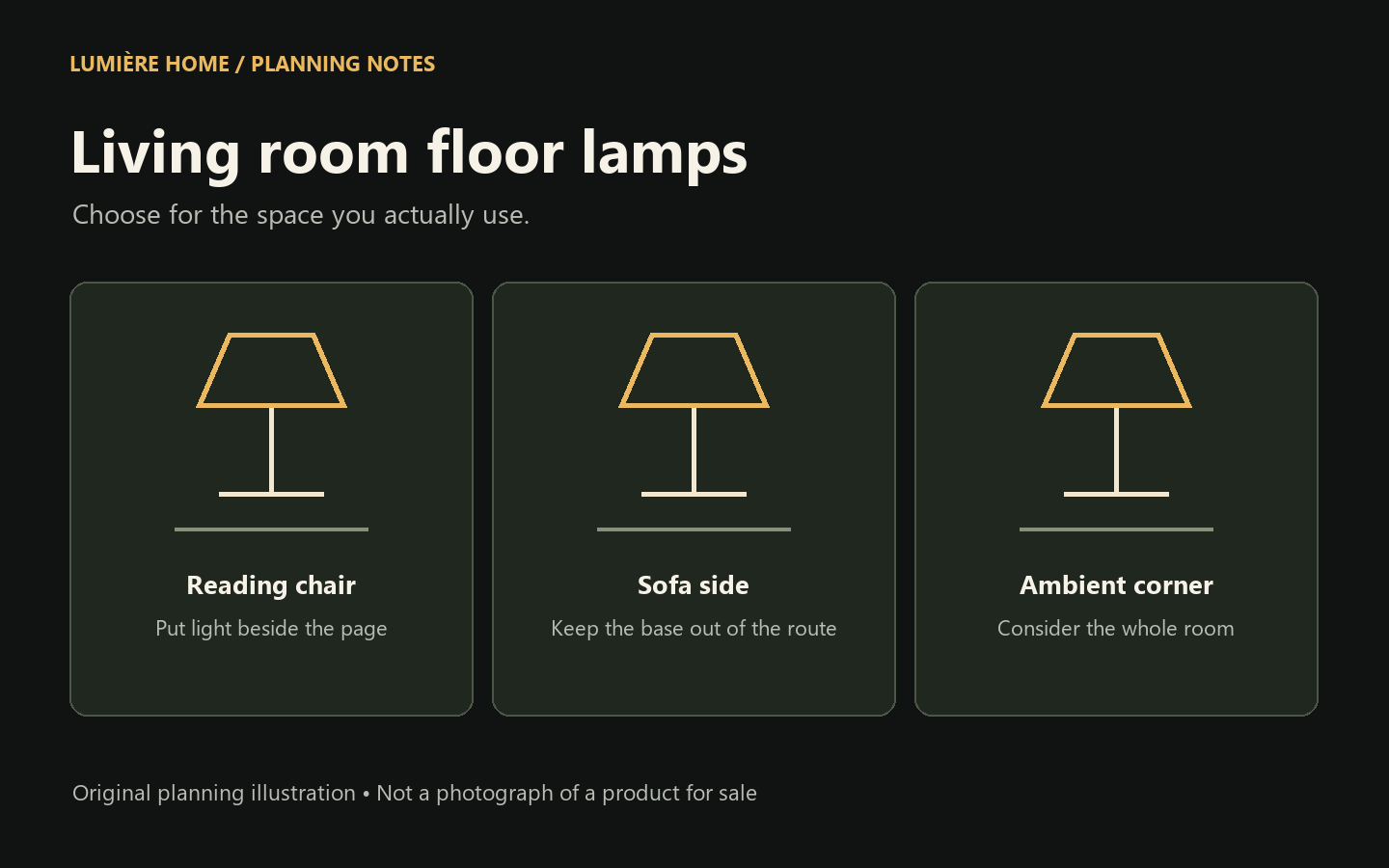
Start here: Start with the seat or area that needs light. A reading chair usually needs a directed beam nearby; a dark corner may benefit from light spread onto surrounding surfaces. Decide which problem you are solving before choosing an arc, tripod or shaded design.
Quick comparison
Type | Useful placement | Measure before buying |
|---|---|---|
Shaded standing | Beside seating | Base and shade clearance |
Adjustable task | Reading chair | Reach and head movement |
Arc | Over a sofa-side area | Base, extension and overhead reach |
Uplight | Ambient corner | Height and ceiling relationship |
Give the floor lamp a place and a purpose
Draw the living room from above and mark the sofa, chairs, doorways and outlets. Include the paths you walk through when carrying drinks or moving between rooms. A floor lamp’s base must fit outside those paths, even if the shade reaches over the seating.
Look at the room after dark with the existing lights on. A corner that feels dark in a daytime photograph may not need another fixture. The best addition fills a real gap rather than repeating light already supplied by a ceiling fixture or table lamp.
Compare the main designs
A shaded standing lamp usually adds a pool of light around a seat and nearby wall. An uplight sends light toward the ceiling, so ceiling height, finish and surrounding surfaces affect the result. A task-style floor lamp aims light toward a page or hobby surface.
An arc floor lamp can bring a shade over a sofa or coffee table from a base positioned to the side. Its reach is useful, but the footprint and overhead clearance can be substantial. Check the full extension dimensions; the base width alone does not describe the space it occupies.
A tripod design often has a wider footprint than a single-stem lamp. It can be a strong decorative choice in an open corner but awkward between a chair and a busy doorway. Think about the space between the legs as well as the outer dimensions.
Check the seated view
Sit in the chair or sofa where the lamp will be used. The light source should not glare directly into your view, and the shade should not obstruct a conversation across the room. A tall lamp can still expose its bulb if the shade is shallow or tilted.
For reading, check whether the light reaches the page when you hold it naturally. Do not solve a poor beam angle by leaning toward the lamp. An adjustable head can accommodate different seats, though its joints and reach need enough space to move.
Consider the television from the same position. A lamp can reflect in the screen even when it looks attractive from the doorway. Moving it a small distance or selecting a more shielded shade may be more useful than simply lowering the brightness.
Plan power, stability and daily movement
Choose a location near an outlet so the cord follows a protected route rather than crossing the floor. Check that the base rests on a level surface. A lamp partly on a thick rug and partly on the floor can sit differently from how it appears in a studio photograph.
Measure behind and beside the sofa before ordering a heavy-base arc lamp. Moving a large lamp repeatedly can be inconvenient, and furniture may trap its cable or prevent the stem from reaching the intended position. Plan for cleaning access as well as the first installation.
If children or pets regularly move through the area, assess whether the chosen position is likely to be bumped. Do not interpret a substantial-looking base as a verified stability or safety rating. Read the assembly and placement instructions for the exact model.
Match the light to the rest of the room
A floor lamp does not have to match every finish in the living room. Repeat one element—such as a dark metal detail, a rounded shade or a textile color—to connect it with nearby furniture. A lighter shade can feel quieter beside a patterned chair; a sculptural lamp can provide a focal point in a simpler room.
Compare output, bulb compatibility and dimming in the listing. Lumens tell you about output, while color temperature describes the light’s appearance. Neither number alone establishes how the shade distributes the light around your room.
For a layered arrangement, use a floor lamp for the reading seat and a smaller table lamp for atmosphere elsewhere. The living room lighting guide explains whole-room layouts. This page focuses on choosing the floor lamp itself and checking that it fits the space you actually have.
Questions before you buy
Can an arc lamp fit a small living room?
Possibly, but compare its complete footprint and reach with the layout. A slimmer shaded or task lamp may fit a tight corner more easily.
Should the lamp sit behind or beside the sofa?
Choose the position that keeps the base and cable clear of movement and puts useful light where needed. Check the seated view and television reflections in either position.
Explore the right lighting category
Browse the related Lumière Home collection. Compare each listing’s dimensions, power source, included parts and installation requirements before ordering. The category contains different models; specifications do not transfer from one product to another.
Sources and editorial approach
Written by Lumière Home. This is a planning and shopping guide, not a laboratory test or an independent review of every product shown in the collection. Illustrations are original planning diagrams, not photographs of products for sale.
Written by Lumière Home