Compare ceiling lights for low ceilings, open rooms and defined dining areas. Understand fixture drop, light spread, glare and the checks to make before installation.
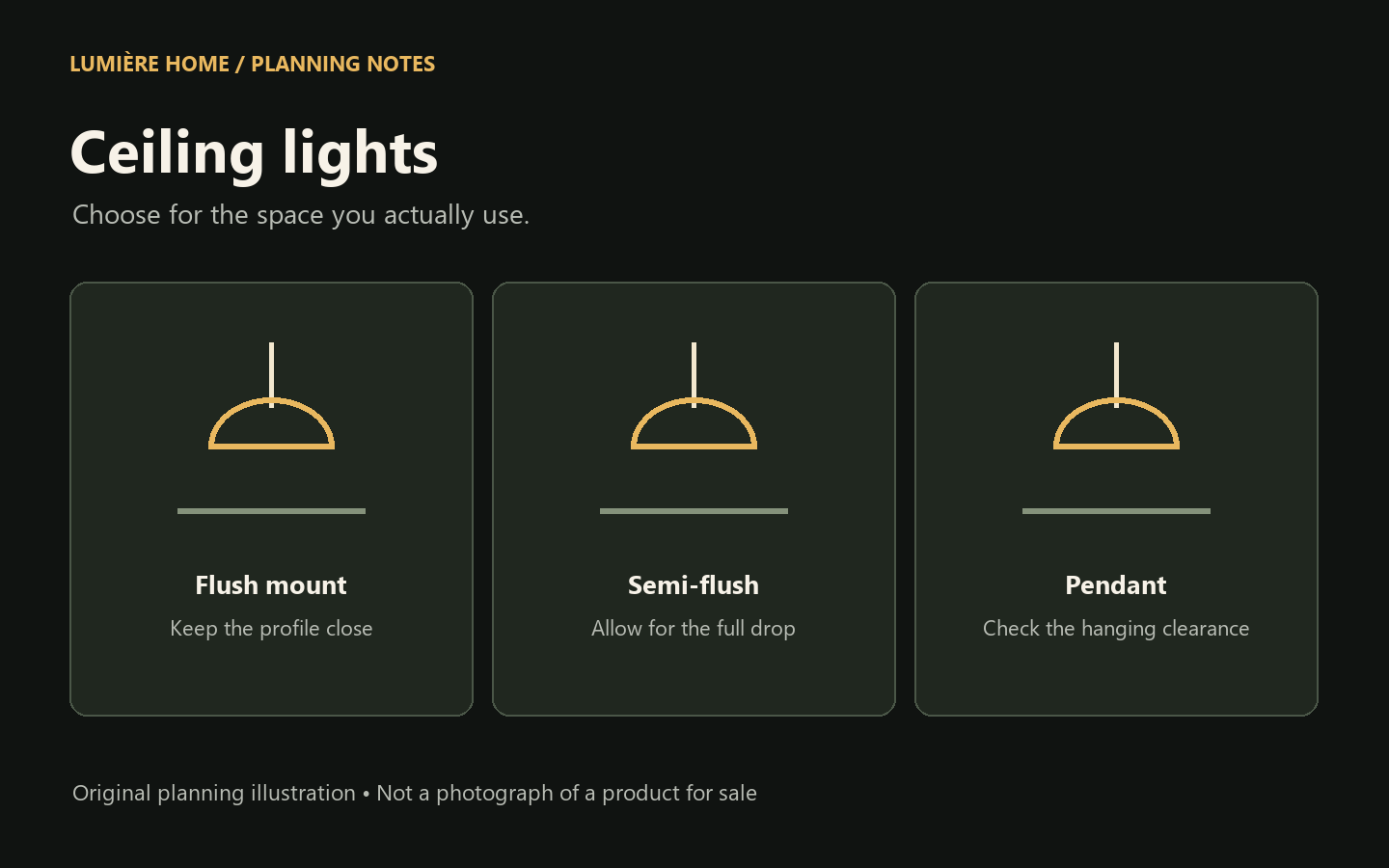
Start here: A flush-mount ceiling light sits close to the ceiling, a semi-flush fixture leaves a short gap, and a pendant hangs farther below it. Choose among them by the available clearance and the role of the light, then compare finishes and shapes.
Quick comparison
Type | Good starting situation | Trade-off |
|---|---|---|
Flush mount | Limited drop or quiet ceiling | Check diffuser and output |
Semi-flush | Some vertical space | More visible profile |
Pendant | Defined table or island zone | Requires suitable clearance |
Compare the drop before the decoration
Measure the ceiling and mark the lowest point of the proposed fixture. Include the canopy, stem and shade in the total drop. People walking beneath it need a different arrangement from a fixture hanging over a fixed dining table.
Look at doors, cabinets and nearby shelves as well as floor clearance. A new fixture should not interfere with an opening door or look unexpectedly crowded beside tall furniture. Ask a qualified installer to confirm the final position and mounting suitability.
When a flush mount makes sense
A flush mount is a useful starting point for rooms where you want a quieter ceiling or have limited vertical space. It can provide general illumination without a long hanging element. The shade design still affects how much light reaches the room.
An enclosed diffuser may hide the light source, while an open design can expose bulbs from certain angles. Check the view from seated and standing positions. A low-profile fitting does not automatically mean low glare, and a large shade does not establish high output.
Read the dimensions carefully: diameter, depth and mounting plate are different measurements. If replacing an existing fixture, confirm whether the new canopy covers the old opening and marks. A larger canopy can change the appearance even when the main shade is compact.
Why choose a semi-flush fixture?
A semi-flush light creates more separation from the ceiling and can give the fixture a stronger presence. Some designs send light upward as well as downward, but that depends on the actual openings and light-source position.
The extra drop can be useful visually in a room where a flush mount feels too flat but a pendant would hang too low. Compare the whole profile with the room, not merely the style name. “Semi-flush” describes a form; it does not supply a universal clearance measurement.
Cleaning and bulb access matter. Check whether a glass bowl, decorative trim or diffuser must be removed for maintenance and whether replacement parts are available. A complicated fitting can become inconvenient in a spot that is difficult to reach.
When a pendant is the better option
A pendant works well when you want to identify a zone, such as a dining table or island. It can act as a visual anchor in an open room, but it is less flexible if the furniture beneath it will move often.
Consider the view across the space. A large opaque shade may dominate a small room; a lighter or more open form may preserve the sightline but expose the bulb. Neither is inherently better. Choose the balance between visual presence and light control that suits the layout.
Check the adjustable drop and mounting compatibility, particularly for sloped or unusually high ceilings. Do not shorten, alter or adapt a fitting based on an assumed standard. Follow the model’s instructions and have the installation assessed professionally.
Evaluate the light, not just the silhouette
Decide whether this ceiling light supplies general room illumination or mainly decorates a zone. General lighting should work with the room’s size and surfaces; detailed tasks may need their own directed light. A single ceiling fixture need not perform every job.
Check stated output, replaceable or integrated light source, dimming and compatible controls. A shaded fitting can change how useful the output feels in the room. Watts indicate power use, while lumens describe light output; compare the appropriate specification.
Finally, confirm included parts, electrical suitability for the U.S., location rating and installation cost. Use only fixtures specified for the intended environment. A dry indoor ceiling light should not be assumed suitable for a damp or outdoor location because it has a similar appearance.
Questions before you buy
Is a flush mount always better for a low ceiling?
It is a useful starting point, but the complete fixture depth and room clearance still need checking.
Can a ceiling light be installed in any room?
No. Confirm electrical and mounting suitability and the stated location rating. Installation requirements depend on the fixture and room.
Explore the right lighting category
Browse the related Lumière Home collection. Compare each listing’s dimensions, power source, included parts and installation requirements before ordering. The category contains different models; specifications do not transfer from one product to another.
Sources and editorial approach
Written by Lumière Home. This is a planning and shopping guide, not a laboratory test or an independent review of every product shown in the collection. Illustrations are original planning diagrams, not photographs of products for sale.
Written by Lumière Home