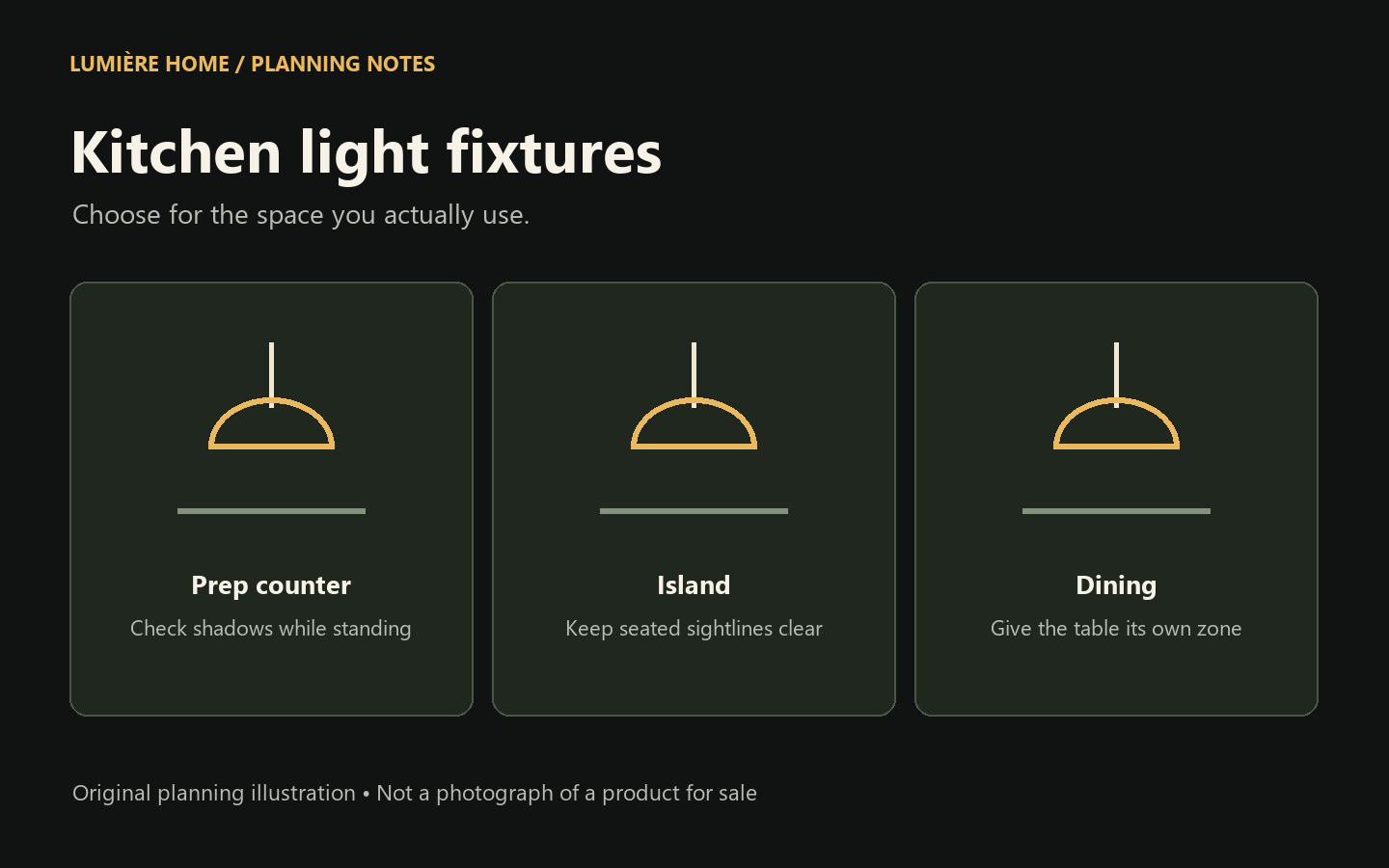
Kitchen Light Fixtures: Plan Prep, Island and Dining Zones
Choose kitchen light fixtures by the work and layout below them. Plan general, preparation and dining light before comparing decorative pendants and ceiling fixtures.
Start here: Plan kitchen light fixtures around the places you prepare food, wash dishes, move through the room and sit down to eat. A decorative island pendant cannot be assumed to cover all of those areas.
Quick comparison
Zone | Lighting job | First check |
|---|---|---|
General room | Movement and orientation | Distribution and ceiling clearance |
Preparation counter | Useful light on the surface | Shadows while standing |
Island | Work or dining focus | Scale and seated sightline |
Dining table | A distinct evening zone | Furniture position and controls |
Map what the kitchen needs to do
Draw the kitchen from above and label the sink, counters, cooktop, island and dining table. Note where upper cabinets or your own body block the existing light. Test the room after dark; daylight can hide a shadow problem that appears every evening.
Make a separate list of the atmosphere you want when the kitchen is not being used for cooking. The same room may need useful preparation light and a lower evening setting. Planning separate controls can make those uses easier, subject to fixture and control compatibility.
General light keeps the layout readable
Ceiling fixtures provide a starting layer for moving around the kitchen and seeing the room. Select the form with the ceiling clearance and layout in mind. A flush or semi-flush fixture may be more practical in a low room than a hanging shade over an open path.
Look beyond the center of the room. If a fixture mainly lights the floor behind you, the counter in front of you may remain shadowed. That is a distribution problem, not necessarily a reason to buy a more decorative fixture with a larger shade.
For an open kitchen, consider how the ceiling fixture relates to the dining and living areas. Coordinating one finish or shape can connect the rooms without using the same fixture everywhere. Give each zone the light it needs.
Preparation areas need their own assessment
Check where light falls on the actual countertop while you stand in your usual position. Upper cabinets can interrupt ceiling light, and a person standing at the counter can cast a shadow onto the work.
Under-cabinet light is one way to address that gap, provided the model, mounting and electrical installation suit the cabinet system. Compare the full run of cabinetry, corners and any breaks rather than buying one length and assuming it fits.
Do not treat a small decorative table lamp as a substitute for specified preparation lighting. Keep portable lamps and charging equipment away from water, hot surfaces and food-preparation clutter, and follow the product instructions for the intended use.
Choose an island fixture by the island
Decide whether the island is mainly a work surface, a place for meals or both. Then compare a single pendant, several smaller pendants or a linear fixture. The combined visual width matters as much as the size of each shade.
Check the sightline across the kitchen and the view from seated stools. An exposed bulb or low shade can be distracting from those positions. Use a simple paper mockup to judge the scale, leaving space at the island ends and between fixture shapes.
The Lumens pendant guide discusses sizing, spacing, height and fixture formats. Use those dimensions as planning references, then confirm the exact model and installation with a qualified professional. Furniture height, fixture construction and ceiling conditions can change the final arrangement.
Separate dining atmosphere from working light
If the kitchen includes a dining table, a fixture centered on that table can establish its own zone. Consider whether the table will stay in that position. A hanging light can become awkward when the furniture moves into a walkway.
Check dimming for the chosen fixture and light source if you want different settings for cooking and dinner. A dimmable label on one component is not proof that the entire system works together. Ask about the complete fixture, bulb and control combination.
Choose shade materials that you can maintain in a kitchen environment. Read the care instructions, inspect bulb access and include cleaning effort in the decision. A beautiful texture that is difficult to clean may be better suited to another room.
Before ordering
Record each fixture’s purpose, location, dimensions, power requirements and included parts. For U.S. use, verify electrical suitability and the correct location rating for the specific model. Check delivery and return terms before scheduling installation.
Ask an installer about mounting, control compatibility and the complete installed cost before purchasing hardwired fixtures. This guide supports selecting and planning; it does not provide electrical wiring instructions. Start with the function of each zone and let the decorative decisions follow.
Questions before you buy
Do kitchen fixtures have to match?
No. A repeated finish or shape can connect different fixtures while each one serves its own zone.
Are three island pendants always necessary?
No. Compare island dimensions, fixture size and the view through the room. A single or linear fixture can be more appropriate.
Explore the right lighting category
Browse the related Lumière Home collection. Compare each listing’s dimensions, power source, included parts and installation requirements before ordering. The category contains different models; specifications do not transfer from one product to another.
Sources and editorial approach
Written by Lumière Home. This is a planning and shopping guide, not a laboratory test or an independent review of every product shown in the collection. Illustrations are original planning diagrams, not photographs of products for sale.
Written by Lumière Home