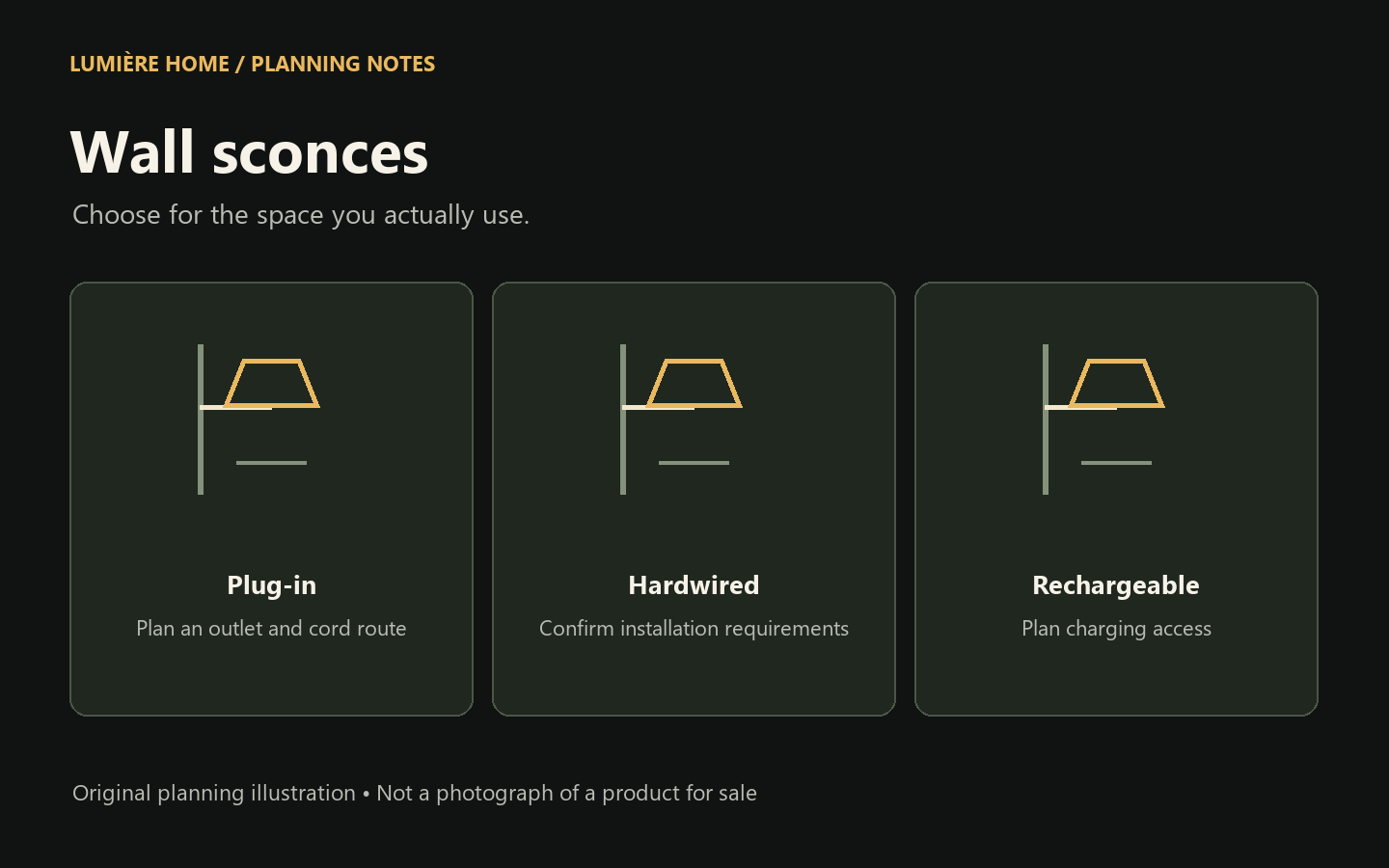
Compare wall sconces by power source, light direction and placement. Plan bedside, hallway and accent lighting without buying a fixture that cannot fit the wall.
Start here: A wall sconce can add atmosphere, direct light onto a page or emphasize a feature while keeping a table clear. Choose its purpose and power source before deciding on the finish. Plug-in, hardwired and battery designs have different daily and installation requirements.
Quick comparison
Power option | Useful advantage | Responsibility to plan |
|---|---|---|
Plug-in | No new lighting wiring point | Outlet, cord and mounting |
Hardwired | No visible plug-in cable | Professional installation and controls |
Battery or rechargeable | Cordless use position | Runtime and charging access |
Choose the job and the power source
For a bedside position, check where the controls will be relative to a seated person. For a hallway, check how far the fixture projects into the route. For an accent wall, decide whether you want to see the fixture itself, the illuminated surface or both.
Draw the wall with nearby doors, furniture and outlets. A fixture that appears compact in a front photograph may extend substantially from the wall. Record its projection as well as its width and height.
Plug-in sconces
A plug-in sconce can be useful where there is no existing hardwired lighting point. It still needs a secure mounting method and a suitable outlet within cable reach. Check the manufacturer’s mounting instructions rather than assuming adhesive or a temporary fixing is sufficient.
Plan the visible cord before choosing the fixture. A cable cover may make the route look tidier, but it does not eliminate the need for a safe, unobstructed path. Check the switch location and whether it will remain reachable behind furniture.
For a rental, confirm permission before making holes or installing cable covers. A plug-in fitting avoids some wiring work, but it does not automatically make installation damage-free. Read what is supplied and what additional hardware is required.
Hardwired sconces
A hardwired sconce can create a cleaner finished appearance without a visible plug-in cable. Its position is more fixed, so decide on the furniture layout and intended use before installation. Moving it later may involve more than shifting a lamp.
Have a qualified professional assess the existing wiring, mounting point, fixture compatibility and control arrangement. Include installation work in the comparison with plug-in models. Two identical sconces can have very different total costs depending on the room’s current setup.
Verify the exact model for U.S. electrical use and the intended location. Indoor dry-location, damp-location and outdoor requirements are not interchangeable. A similar shape or metal finish is not evidence that a fixture is suitable for a bathroom or exposed location.
Battery and rechargeable sconces
Battery sconces can avoid a live cable at the use position, but they introduce replacement or charging routines. Check whether the fixture is genuinely rechargeable, uses replaceable batteries or merely includes a decorative battery-operated bulb.
Look for stated runtime at a relevant brightness setting and check how the light is removed or accessed for charging. A model mounted high on a wall may be inconvenient to recharge frequently. Battery capacity alone does not establish a useful duration.
Some cordless sconces are mainly accent lights. If the intended job is reading or illuminating a hallway, verify their output and distribution instead of assuming they perform like a mains-powered fixture. Choose the category by function, not by a photograph of an illuminated shade.
Direct the light where it helps
An uplight emphasizes the wall above the fixture; a downlight highlights the area below. A shaded sconce can add surrounding glow, while an adjustable head gives more control over a task. The actual beam depends on construction and light-source position.
Mock up the fixture’s shape on the wall and check it while seated or walking through the space. Keep a bare bulb out of the direct view where possible. Around a mirror, examine the effect on the face rather than placing fixtures only for symmetry in a photograph.
For a pair beside a bed, compare reach and sightlines from both sides. The same mounting position may not suit different nightstands or users. Choose the final position after considering the exact fixture and installation requirements, not a single universal height rule.
Order with the full specification
Before buying, confirm dimensions, wall projection, power source, controls, included hardware and light-source details. Ask about bulb replacement or integrated-LED service information. Check whether dimming is supported by the complete system.
Browse the wall-light collection by the specific job you need it to do. Individual listings can differ substantially even when the designs look related. If installation, output or compatibility is unclear, resolve it before ordering rather than trying to adapt the product afterward.
Questions before you buy
Are plug-in sconces damage-free?
Not necessarily. The fixture still needs secure mounting and may need holes or a cable cover. Check instructions and rental permission.
Can battery sconces replace hardwired lighting?
Only if their stated output and runtime meet the intended job. Accent models should not be assumed to provide dependable whole-room or task illumination.
Explore the right lighting category
Browse the related Lumière Home collection. Compare each listing’s dimensions, power source, included parts and installation requirements before ordering. The category contains different models; specifications do not transfer from one product to another.
Sources and editorial approach
Written by Lumière Home. This is a planning and shopping guide, not a laboratory test or an independent review of every product shown in the collection. Illustrations are original planning diagrams, not photographs of products for sale.
Written by Lumière Home