Pendant Lights: Compare Shapes, Materials and Room Uses
Choose pendant lights by where they hang, how they distribute light and how they look from nearby rooms. Compare shade materials, single pendants and linear designs.
Start here: A pendant light hangs below the ceiling, so its shape affects both the illumination and the view through the room. Start with the surface or area below it: dining table, kitchen island, bedside position or open circulation space.
Quick comparison
Shade or format | Visual effect | Question to ask |
|---|---|---|
Opaque shade | Defined silhouette | Where does the beam go? |
Translucent shade | Visible diffuse glow | How much light reaches the surface? |
Clear glass | Exposed bulb and reflections | Will seated eyes see glare? |
Linear fixture | Long horizontal emphasis | Does the full width suit the table? |
Choose the location first
A pendant above a table can hang in a space that people do not normally walk through. A fixture in an open walkway needs a different clearance decision. Do not transfer a dining-table hanging measurement into a hallway. Ask a qualified installer to assess the intended location and the manufacturer’s requirements.
Look at the fixture from the entrance, from seated positions and from adjacent rooms. An open-plan kitchen pendant becomes part of the living room view, so scale and visual weight matter beyond the island itself.
Understand shade materials
An opaque shade can concentrate light through its openings, which may suit a surface below. A translucent shade spreads a softer-looking glow around the fixture. A clear glass shade puts the bulb on display and can add sparkle, but it may also expose a bright source to seated eyes.
Metal, glass, fabric and woven materials create different visual effects even when their outside dimensions match. A dense woven shade can cast patterns; a smooth diffuser can look more even. Read the listing and look for illuminated photographs rather than assuming how an unlit shade will behave.
Consider cleaning in the intended room. Kitchen fixtures can collect residue, while textured shades may need more careful care. Check the specified cleaning method and whether the shade can be removed. Avoid choosing a material solely because it looks good in a staged photograph.
One pendant or a group?
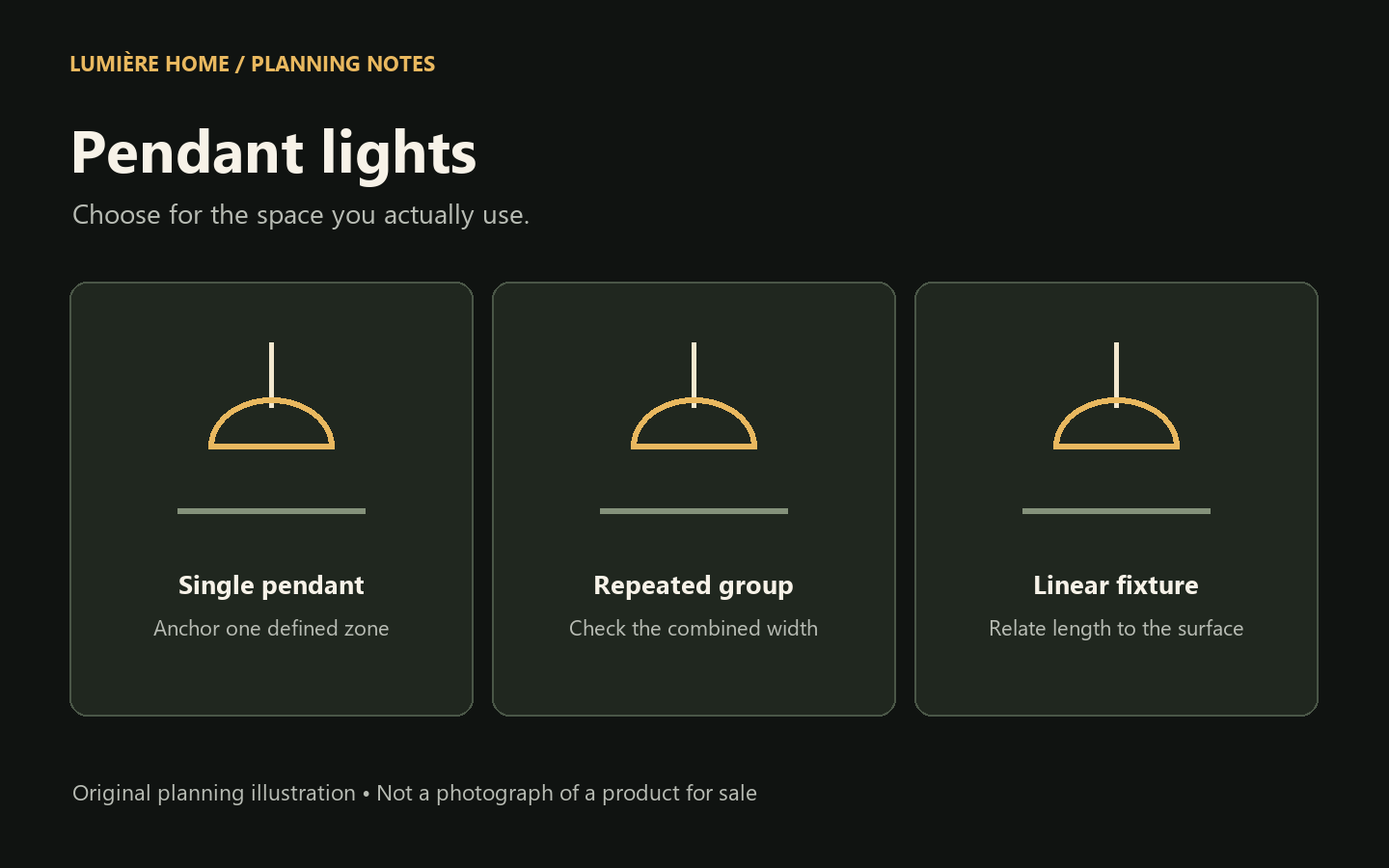
A single larger pendant can give a table a clear center. Several smaller pendants create repetition, while a linear fixture relates naturally to a long surface. The right choice depends on the furniture shape, available width and how much ceiling detail you want.
Before buying a group, sketch the proposed shade positions and compare the combined width with the table or island. Leave visual space at the ends and check whether the shades obscure faces or views. The number of pendants is a design choice, not a universal rule that every island needs three.
Grouping fixtures also changes the installation plan. Confirm the mounting points, adjustment range and whether a multi-light fitting is a single assembly or separate units. Ask for the complete installation cost before treating several small pendants as the cheaper option.
Check light and control requirements
A decorative pendant may provide atmosphere without fully lighting a working surface. If it is your intended task light, check the output and beam distribution. In a kitchen, other ceiling or under-cabinet light may still be needed to cover preparation areas.
Replaceable-bulb pendants require the specified socket, bulb size and permitted wattage. Integrated-LED pendants require attention to their output and service details. For dimming, verify compatibility among the fixture, light source and control. Do not assume a dimmer can be added to every model.
Compare the light appearance with nearby fixtures. A strong difference between pendants and adjacent lamps can be deliberate, but decide before purchasing. Changing the shade material later may be more difficult than changing a compatible replaceable bulb.
Prepare a purchase brief
Record the ceiling height, furniture dimensions, proposed hanging position and any obstacles. For a sloped ceiling, verify the model’s mounting compatibility. Check the minimum and maximum drop rather than looking only at the fixture height.
Confirm the U.S. electrical suitability of the exact model, installation requirements and included hardware. A photograph of a plug or canopy does not establish compatibility. Hardwired work belongs with a qualified professional; this guide is for selecting a fixture, not wiring one.
Use a paper silhouette or a lightweight mockup to judge the scale before committing. View it from the places where you spend time, not just from directly underneath. The aim is a fixture that suits the room every day, rather than one that only looks convincing in a close-up product image.
Questions before you buy
Can any pendant hang on a sloped ceiling?
No. Verify the mounting system’s stated compatibility and ask the installer to confirm the model for your ceiling.
Are pendant lights enough for a kitchen?
That depends on their output, placement and the kitchen layout. Plan separate light for preparation areas instead of assuming decorative pendants cover every task.
Explore the right lighting category
Browse the related Lumière Home collection. Compare each listing’s dimensions, power source, included parts and installation requirements before ordering. The category contains different models; specifications do not transfer from one product to another.
Sources and editorial approach
Written by Lumière Home. This is a planning and shopping guide, not a laboratory test or an independent review of every product shown in the collection. Illustrations are original planning diagrams, not photographs of products for sale.
Written by Lumière Home