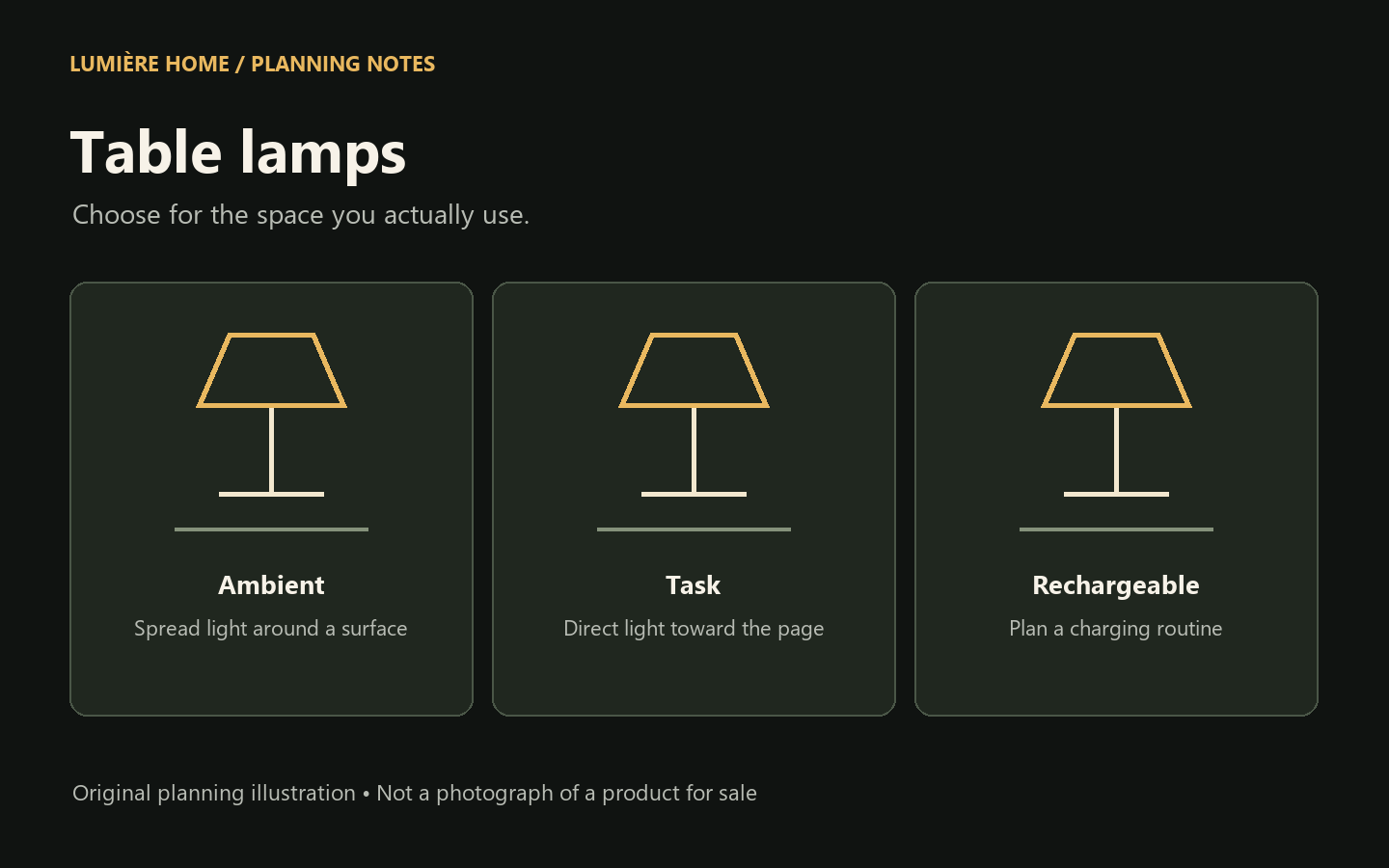
Choose a table lamp that fits the surface and the job. Compare shade styles, plug-in and rechargeable power, controls and the details worth checking before buying.
Start here: Decide whether the table lamp needs to light a page, create a softer evening atmosphere or decorate a shelf. A lamp that looks beautiful in a product photograph may not provide the direction or brightness you need for reading.
Quick comparison
Option | Useful for | Check first |
|---|---|---|
Shaded plug-in | Regular ambient use | Shade width, cable and bulb |
Directed task lamp | Reading or detailed work | Beam position and output |
Rechargeable accent | Moving between surfaces | Charging and stated runtime |
Choose the job before the shape
For a sofa-side table, think about the seated view and where the switch will sit. For an entry console, look at how the lamp appears from the doorway and whether its base leaves space for keys. For a dinner table, check that its shade does not block faces. These three uses can lead to very different purchases.
Write a one-sentence brief before browsing: “I need a lamp for a narrow console, mostly for evening atmosphere, with an accessible switch.” That brief is more useful than choosing a style first and trying to make it fit afterward.
What the shade changes
A translucent fabric or frosted shade can spread light around the room. An opaque metal shade often directs more of it through an opening. A clear shade exposes the light source, which can look decorative but also create glare. These are starting points; the bulb position and fixture construction still matter.
Compare the shade width with the available table depth, not only with the lamp base. A narrow base beneath a wide shade can still overhang a small nightstand. Check the opening, the suggested bulb and whether the shade is included. A photograph alone does not establish any of those details.
If the lamp uses a replaceable bulb, inspect its socket and maximum permitted wattage. If the LEDs are built in, ask what happens when the light source reaches the end of its life. A replaceable shade or bulb can make later changes easier, but only when the parts are actually compatible.
Plug-in or rechargeable?
A plug-in table lamp is convenient for regular use in one location near an outlet. Plan the cable route before buying: it should not stretch across a walking path or become trapped under furniture. Check the cable length and the position of any inline switch.
A rechargeable table lamp is useful when you want to move the light or keep a tabletop free of cables during use. It still needs a charging routine. Battery capacity is not the same as verified runtime, and runtime can vary with the brightness setting. Look for measured or clearly stated information rather than assuming an evening of use.
For a compact accent, our cordless rechargeable mushroom table lamp measures approximately 3.9 inches wide by 6.3 inches high. It offers USB-C charging and touch dimming with three light tones. Its lumen output and runtime are not verified, so it is an ambient option rather than our recommendation for demanding reading tasks.
Compare brightness and controls separately
Lumens describe light output; watts describe power use. Kelvin describes the appearance of the light. These figures answer different questions. Choosing a cooler tone does not establish that a lamp has higher output, and a low wattage does not tell you how useful the light will be on your desk.
Try the control location in your planned arrangement. A touch surface on the base may be simple on a clear table but awkward behind books. A switch under the shade may be out of reach from a deep sofa. If dimming matters, check that the lamp, bulb and dimmer are compatible rather than treating “LED” as a dimming guarantee.
Photographs can exaggerate both the size and the brightness of a small lamp. Use listed dimensions and output specifications for the purchase decision. For a dedicated reading spot, prioritize directed illumination and glare control before a dramatic sculptural shape.
Make a short shopping checklist
Measure the surface, mark the lamp’s proposed footprint with paper and leave space for the objects you use daily. Then record the maximum shade width, total height, nearby outlet and preferred control position. Compare those numbers with the actual listing.
Check what the box contains: lamp, shade, bulb, charging cable and adapter may be separate items. Look at the selected color’s photograph and the return terms before paying. For the rechargeable mushroom model, a USB cable is included; do not assume a wall adapter is supplied.
If two lamps will flank a sofa or sit on a long console, decide whether you want a matching pair or coordinated shapes. A shared finish or shade color can connect different lamps without forcing identical heights. Choose the arrangement that leaves the surfaces useful, not merely symmetrical.
Questions before you buy
Can a table lamp replace a ceiling light?
Sometimes it can provide the atmosphere you want in one area, but a small accent lamp should not be assumed to illuminate a whole room. Match the output and distribution to the room and retain other light for movement and tasks.
Do all table lamps include a bulb?
No. Read the included-parts list and the specified socket or integrated-LED details. Buying the right bulb separately can be part of the total cost.
Explore the right lighting category
Browse the related Lumière Home collection. Compare each listing’s dimensions, power source, included parts and installation requirements before ordering. The category contains different models; specifications do not transfer from one product to another.
Sources and editorial approach
Written by Lumière Home. This is a planning and shopping guide, not a laboratory test or an independent review of every product shown in the collection. Illustrations are original planning diagrams, not photographs of products for sale.
Written by Lumière Home