Under-Cabinet Kitchen Lighting: A Practical Guide
Add under-cabinet kitchen lighting for shadow-free counters, with a plain guide to strip, puck, and bar lights, placement, brightness, and color temperature.
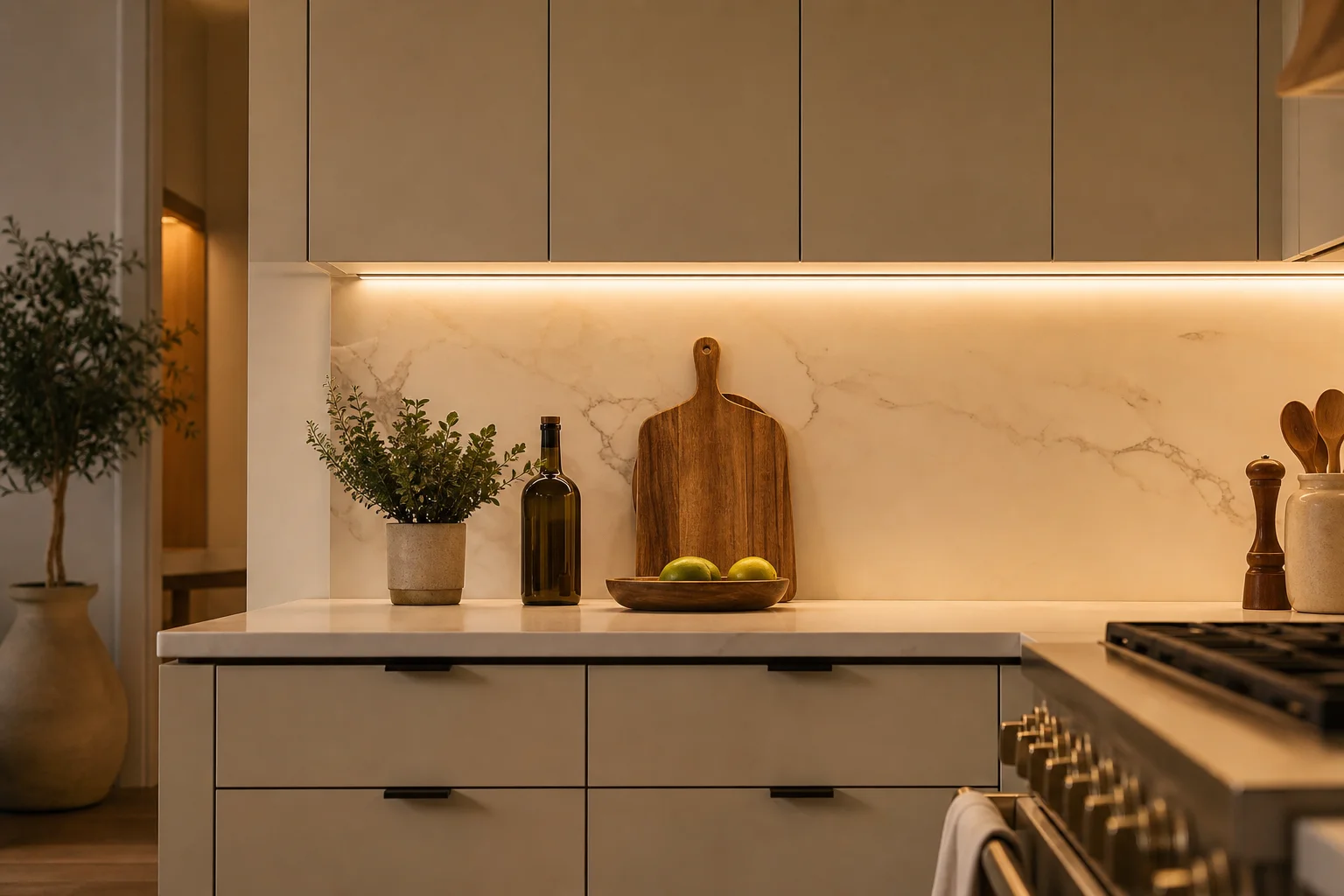
Under-cabinet lighting checklist
- Add under-cabinet light to remove counter shadows.
- Use continuous strips or bars for even light.
- Mount toward the front edge of the cabinet.
- Choose about 3000K–4000K for task work.
- Pick plug-in or battery options for easy install.
Why under-cabinet light matters
Overhead kitchen lights sit behind you as you work at the counter, so your own body casts a shadow onto the work surface. Under-cabinet lighting puts light directly where you chop, read recipes, and prep, removing that shadow.
It is one of the most useful kitchen upgrades because it improves both safety and comfort without changing the whole ceiling layout.
Choose the type of fixture
Strip or tape lights give a continuous, even line of light and are ideal for lighting a whole run of counter. Bar or linear fixtures are slightly bulkier but easy to mount and wire. Puck lights create pools of light, good for accent spots or short sections.
For even task light along a counter, a continuous strip or bar usually beats spaced puck lights, which can leave darker gaps between pools.
Position the fixtures well
Mount the lights toward the front edge of the underside of the cabinet rather than the back. This aims light onto the counter and reduces reflections off a glossy backsplash.
A diffused fixture or a lens softens hotspots and hides individual points of light, which looks cleaner and is more comfortable to work under.
Set brightness and color
Aim for bright, even task light along the counter; adding under-cabinet light meaningfully increases usable brightness where you actually work. Choose a color around 3000K–4000K for clear task visibility that still feels comfortable.
Match the under-cabinet color temperature to the rest of the kitchen so the counters do not look noticeably warmer or cooler than the room.
Plan power and control
Some under-cabinet lights plug into an outlet, while others are hardwired for a cleaner look. Plug-in and battery or rechargeable options are the easiest to add without an electrician.
A dimmer or a separate switch lets you use bright light for cooking and a low glow as a night light. Follow the fixture instructions and use a qualified electrician for hardwired installs.
Frequently asked questions
What is the best under-cabinet kitchen lighting?
For even task light along a counter, continuous strip or bar lights usually beat spaced puck lights, which can leave darker gaps. Mount the fixtures toward the front edge of the cabinet and choose a diffused option to soften hotspots.
Why add under-cabinet lighting?
Overhead lights sit behind you at the counter, so your body casts a shadow on the work surface. Under-cabinet lighting puts light directly where you chop and prep, improving both safety and comfort without changing the ceiling layout.
What color temperature for under-cabinet lights?
Choose a color around 3000K–4000K for clear task visibility that still feels comfortable, and match it to the rest of the kitchen so the counters do not look noticeably warmer or cooler than the room.
Related lighting guides
- How Many Lumens Do You Need? A Room-by-Room Guide
- Ambient Lighting vs. Task Lighting
- Light Bulb Color Temperature Guide (Kelvin)
Guidance is based on established residential-lighting conventions. Verify room measurements, local requirements, and product instructions before installation or use.