Table Lamp vs Floor Lamp: Which One Does Your Room Actually Need?
The short answer: choose a table lamp when you have a surface beside the seat and need light for reading or close-up tasks. Choose a floor lamp when there is no surface, when you need to light a corner or a wide area, or when you want height in the room. Most rooms are best served by both — a floor lamp to fill the space and a table lamp to create a pool of light where people actually sit.
This is not really an either/or question, but the practical differences are worth understanding before you spend money on the wrong one.
Table lamp vs floor lamp at a glance
| Table lamp | Floor lamp | |
|---|---|---|
| Needs a surface | Yes | No |
| Typical height | 14–34 in | 58–72 in |
| Light spread | Focused pool, close range | Wide, fills a corner or zone |
| Best for reading | Excellent when beside a seat | Excellent with an adjustable or arc arm |
| Floor space used | None | 1–3 sq ft |
| Typical cost | Lower | Higher |
| Ease of moving | Very easy | Moderate |
| Visual weight | Adds warmth at seated height | Adds height and structure |
When to choose a table lamp
You already have the surface. If there is a nightstand, side table, console or desk in place, a table lamp is the more efficient choice. It costs less, uses no floor space, and puts light exactly where a person's hands and book are.
You want light at seated eye level. This is the real advantage. A table lamp sits in the zone where people are, which is why a room lit by table lamps feels intimate while the same room lit from above feels institutional. A pair of table lamps will transform an evening living room more than any single overhead fixture can.
You are working with a small room. In a studio, small bedroom or apartment living room, floor space is the scarce resource. A table lamp on an existing surface adds light without adding footprint.
You want flexibility. A table lamp can be moved between rooms in seconds, repurposed onto a shelf, or swapped seasonally. It is the lowest-commitment lighting change you can make.
You want a decorative object as well as a light. Because a table lamp sits at eye level on a surface, it functions as a piece of sculpture in the room during the day. A well-chosen lamp earns its place even when switched off — which is why base material, silhouette and finish matter so much in this category.
When to choose a floor lamp
There is nowhere to put a lamp. The classic case: an armchair in a corner with no side table. A floor lamp solves it in one move.
You need to light a dark corner or a wide zone. Floor lamps sit higher, so their light travels further. An uplighter bounced off the ceiling can brighten an entire seating area softly, something no table lamp can do.
The room needs vertical interest. Rooms where everything is at or below waist height feel flat. A tall floor lamp draws the eye up and gives a room proper structure, especially useful with high ceilings.
You want reading light over a sofa. An arc floor lamp reaching over the seat delivers better reading light than a table lamp on a low side table, because it comes from above and behind rather than from the side.
The real answer: layer them
Good lighting is not one fixture doing everything. A well-lit room has three layers:
- Ambient — general fill. Ceiling fixture, or a floor lamp bounced off the ceiling.
- Task — light where you do things. Table lamp beside a chair, desk lamp, adjustable floor lamp by a reading seat.
- Accent — glow and atmosphere. Small table lamp on a shelf or console, dimmed low.
Aim for three to five separate light sources in a living room, at varying heights, each on its own switch. That last detail is what gives you control: being able to run only the two table lamps on a quiet evening, and everything at once when you have people over.
Room by room
Living room
One floor lamp in the darkest corner or behind the main seat, plus two table lamps on side tables. If the room is large, add a third small lamp on a console or bookshelf. Keep every bulb at the same color temperature.
Bedroom
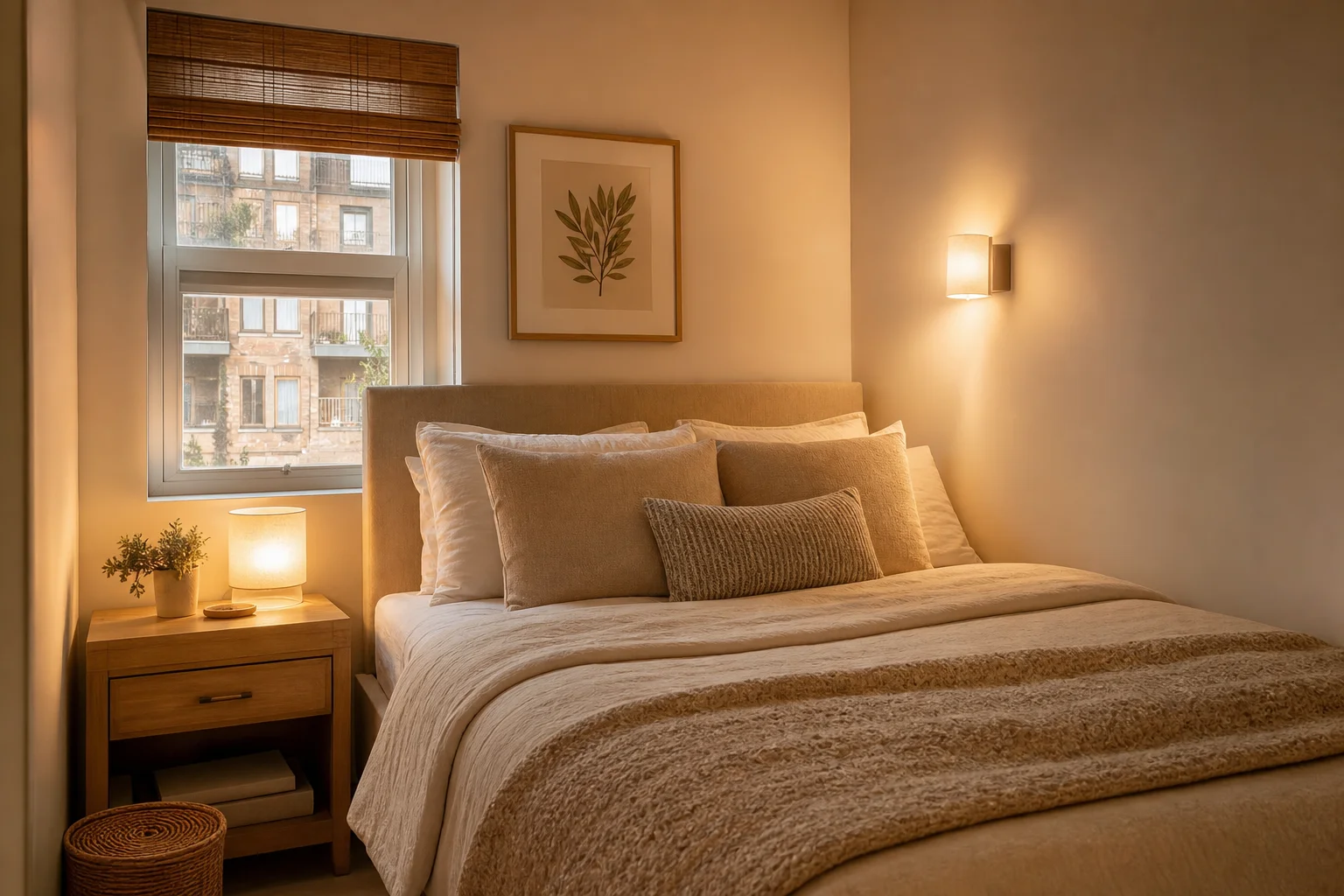
Table lamps win here. One per nightstand, both dimmable and warm. Add a floor lamp only if you have a reading chair or a dark corner. A bedroom lit mainly by low, warm table lamps in the evening genuinely helps you wind down.
Home office
A table or desk lamp is essential for task light — placed to the side of your writing hand so it does not cast a shadow. Add a floor lamp behind or beside the desk to lift the overall level, which reduces the eye strain that comes from a bright screen in a dim room.
Entryway
A table lamp on a console, if you have one. If the hallway is too narrow for furniture, a slim floor lamp works. Keep it low output — this is a transition space, not a task area.
Small apartments and studios
Favor table lamps on existing surfaces plus one slim floor lamp. Compact lamps on shelves and counters are especially valuable here: several small pools of warm light make a small space feel considered rather than cramped, which a single bright overhead never does.
Frequently asked questions
Is a table lamp or floor lamp better for reading?
Both work well. A table lamp is better if you have a surface at the right height beside the seat, since the light lands directly on the page. A floor lamp with an adjustable or arc arm is better when there is no surface, because it can be positioned over your shoulder.
Do I need both a table lamp and a floor lamp in one room?
In a living room, usually yes — the floor lamp fills the space and the table lamp creates warmth where you sit. In a bedroom, table lamps alone are often enough.
How many lamps should a living room have?
Three to five light sources at different heights, ideally on separate switches. That typically means one or two table lamps, one floor lamp, and an overhead fixture.
Are floor lamps brighter than table lamps?
Not inherently — brightness comes from the bulb. Floor lamps often feel brighter because they sit higher and spread light over a wider area, and many take multiple bulbs. See our guide to table lamp brightness and lumens for the numbers.
Can a table lamp replace a ceiling light?
Two or three table lamps can absolutely replace a ceiling light as your main evening lighting, and most rooms look better for it. For cleaning or detailed tasks you will still want a brighter overall source.
Which is better value?
Table lamps generally cost less and, if you already own the side table, deliver more atmosphere per dollar. A floor lamp is worth the extra spend when it solves a problem a table lamp cannot — a dark corner or a seat with no surface beside it.
Building your lighting layers? Browse the Lumière Home collection, see the dimmable mushroom table lamp, or read our table lamp sizing guide.
Written by Lumière Home