How Bright Should a Table Lamp Be? Lumens, Watts and Bulb Colour Explained
"How bright should my table lamp be?" is the question that trips up almost every lighting purchase, because the answer changed when LEDs arrived. Watts used to tell you brightness. Now they tell you energy use, and brightness lives in a different number entirely.
Here is what each number on the bulb box actually means, and the brightness to aim for in every kind of table lamp.
Lumens vs watts: which number is brightness?
Lumens measure light output. Watts measure electricity consumed. An LED bulb producing 800 lumens draws roughly 8 to 10 watts; the old incandescent that produced the same 800 lumens drew 60 watts. Same light, a fraction of the power.
So when you shop for a table lamp bulb, read lumens for how bright it will feel, and watts only to check you are within the lamp's safe limit.
A rough translation table for anyone still thinking in old wattages:
- 25W incandescent ≈ 250 lumens
- 40W ≈ 450 lumens
- 60W ≈ 800 lumens
- 75W ≈ 1,100 lumens
- 100W ≈ 1,600 lumens
How many lumens does a table lamp need?
It depends entirely on the job the lamp is doing. A bedside lamp and a desk lamp have almost opposite requirements.
Bedside table lamp: 400 to 800 lumens
Enough to read a paperback comfortably, gentle enough that switching it off does not feel like a shock. If you read in bed regularly, stay in the upper half of that range. If the lamp is mostly for winding down, 400 lumens with a dimmer is plenty.
Living room table lamp: 600 to 1,200 lumens
Living room lamps are usually doing ambient work as part of a layered scheme, not lighting the whole room alone. Two or three lamps at 700 lumens each will feel far better than one 1,600 lumen lamp trying to do everything.
Desk or task lamp: 800 to 1,100 lumens
Task lighting needs to be brighter than its surroundings but not harsh. Directional shades matter as much as raw output here — the light needs to land on the work surface.
Accent or decorative lamp: 200 to 450 lumens
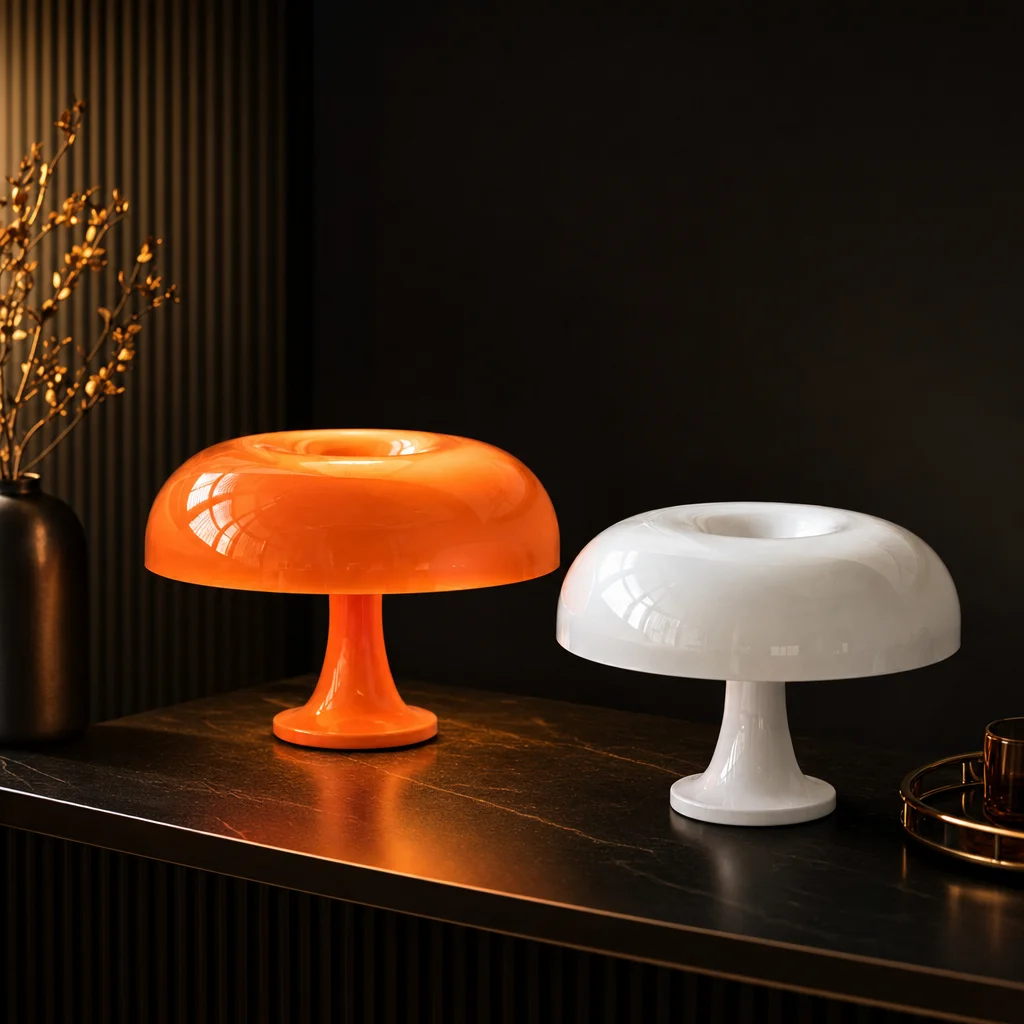
A hallway console lamp, a shelf lamp or a mushroom-style accent lamp exists to create atmosphere and a soft pool of glow. Anything above 500 lumens starts to feel like functional lighting rather than mood lighting.
What wattage bulb can I safely use in a table lamp?
Every lamp has a maximum wattage printed near the socket or on the label. That limit exists to protect the socket, wiring and shade from heat — never exceed it.
The good news: with LEDs it is almost impossible to hit. A lamp rated for a maximum of 60 watts can take an LED bulb producing 1,600 lumens, because that LED only draws about 15 watts. LEDs give you the freedom to go far brighter than an older lamp was ever designed for, safely.
One caveat: an enclosed shade traps heat. If the lamp fully encloses the bulb, choose a bulb rated for enclosed fixtures or the driver will fail early.
Warm or cool light? Understanding colour temperature
Colour temperature is measured in Kelvin (K) and it changes the whole mood of a room more than brightness does.
- 2000K to 2400K — candlelight. Very warm and amber. Beautiful for evening accent lamps, too dim-feeling for reading.
- 2700K — warm white. The classic, cosy home light. This is the right default for almost every table lamp in a bedroom or living room.
- 3000K — soft white. Slightly crisper. Works well in bathrooms, kitchens and some desk setups.
- 4000K — cool white. Neutral and office-like. Fine for a work desk, jarring beside a bed.
- 5000K+ — daylight. Blue-toned. Suits garages and detailed craft work, not living spaces.
If you take one thing away: use 2700K for table lamps in living rooms and bedrooms. It is the single easiest upgrade to how expensive a room feels.
Why dimmable beats bright
A dimmable table lamp solves the brightness question permanently, because you stop having to choose. Full output for reading, 20% for evening, no compromise. If you are dimming, make sure both the bulb and the lamp support it:
- The bulb must say dimmable on the box — many cheap LEDs are not, and will flicker or buzz.
- The lamp needs a dimming mechanism: a rotary base switch, an inline dimmer, a touch control, or a smart bulb.
- Some warm-dim LEDs shift from 2700K toward amber as they dim, mimicking a filament bulb. This is the most flattering evening light you can buy.
Frequently asked questions
Is 800 lumens too bright for a bedside lamp?
It is at the top of the comfortable range — ideal if you read in bed, slightly bright if the lamp is purely for atmosphere. With a dimmer, 800 lumens is the best of both.
How many lumens do I need to read comfortably?
Around 400 to 600 lumens landing on the page, from a lamp positioned beside and slightly behind your shoulder so the light falls on the book rather than into your eyes.
Can I put an LED bulb in an old table lamp?
Yes, as long as the base type matches (E26/E27 screw or E12/E14 candelabra) and the bulb is rated for the fixture. LEDs run cooler than the bulbs the lamp was designed for, so heat is not an issue.
Why does my table lamp flicker when dimmed?
Almost always a non-dimmable bulb, or a mismatch between an LED bulb and an older dimmer built for incandescent loads. Swap to a confirmed dimmable LED first.
Do lumens matter more than the lampshade?
They work together. A dark or lined shade can cut perceived brightness dramatically, while a white linen shade spreads it. Pick the shade for the mood, then pick lumens to match.
Get the light right, then pick the lamp
Decide the job first — reading, ambient or accent — then match lumens and colour temperature to it. Browse table lamps at Lumière Home, or start with our dimmable LED mushroom lamp if you want warm, adjustable light out of the box with no bulb shopping required.
Written by Lumière Home